What is corrective exercise and exercise rehabilitation?
Corrective exercise and exercise rehabilitation is a physiotherapist-led programme that finds the movement pattern behind your pain or weakness and retrains it. At Kinesio Rehab Ipoh, we offer it as a home visit across Ipoh, with our Canning Garden centre opening soon. The aim is simple: move well, carry load safely and trust your body again.
Pain can settle before the cause does. A stiff hip, a weak buttock muscle or a shoulder that has forgotten how to share the work can keep sending the strain to the same sore spot. We look for that cause and train it, so the relief lasts longer than the rest period.
Who does it help most?
It helps people who feel better but not yet right. You may be pain-free at rest yet nervous about lifting a grandchild, climbing the Bukit Kledang trail or sitting through a long workday.
It also suits people returning after surgery or a hospital stay, and older adults who want to stay steady on their feet. An adult child in KL or Singapore can arrange it for a parent in Ipoh and receive the plan by message.
What conditions can corrective exercise help with?
Most movement-related problems can start with an assessment at home. The physiotherapist decides whether exercise is the right next step for your goal.
- Neck, upper back and desk-related strain, as in posture-related pain.
- Low back pain that returns when you sit, lift or bend, see back pain.
- Weak legs, a heavy feeling on stairs or trouble standing up, see muscle weakness.
- Knee pain when you climb, squat or walk far, see knee pain.
- Shoulder and hip problems that limit reaching or walking.
- Loss of fitness after illness, injury or a long break.
Where pain is the main problem, we treat that first, then build the exercise on top.
What techniques does the physiotherapist use?
We combine six methods and choose among them for your body, not a fixed script. Each one answers a different question about how you move.
| Method | The question it answers | What you will do |
|---|---|---|
| Movement assessment | Where does the pattern break down? | Squat, step up, reach, bend and walk while we watch. |
| Mobility work | Which joint is too stiff to share the load? | Gentle, controlled stretches and joint movements. |
| Motor control training | Can the right muscle switch on at the right time? | Slow, small, precise movements with feedback. |
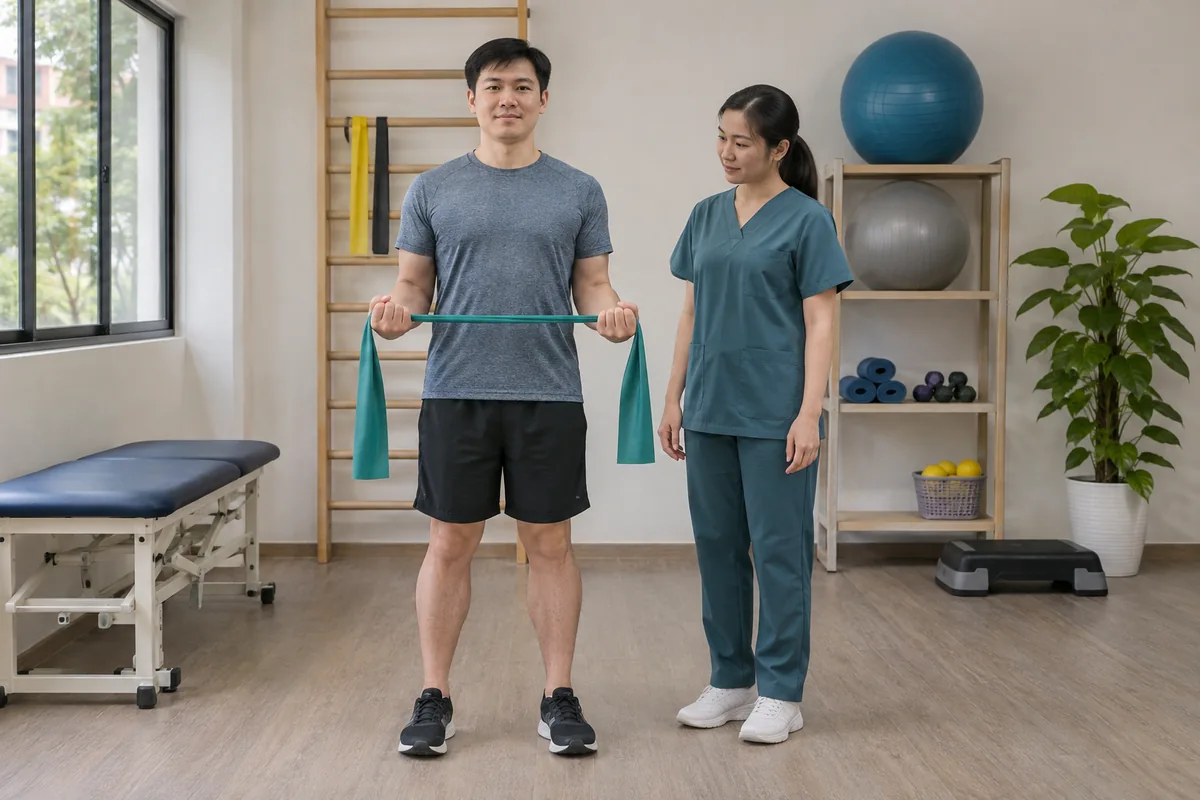
| Strength training | Is the muscle strong enough for your daily load? | Sit-to-stand, step-ups, bridges and resistance band work. |
| Graded loading | How much more can the tissue take today? | Small, planned increases in repeats, weight or speed. |
| Home programme | How do you keep the gains between visits? | A short routine set to your day and your space. |
Movement assessment comes first, and it decides everything after it. We check range, strength, balance and how the body moves as a whole, not only the sore part.
Posture and movement-pattern retraining then follows. We teach a better way to hinge, squat or reach, and practise it until it feels natural, using a mirror or a phone video if helpful. Manual treatment can ease stiffness first, when it helps.
What does the first session look like?
The first session is an assessment and a start, not only a talk. You leave with something to do.
- You message us on WhatsApp with the problem, the area of Ipoh and what you want to do again.
- We reply with questions, how a visit would run and a quote.
- The physiotherapist arrives, listens to your story and asks about pain, medicines, past injuries and your daily tasks.
- We watch you stand, squat, step, reach and walk, and test strength, movement and balance.
- We teach two or three exercises, check your form and agree how frequently to do them.
- We set goals and a review point, and message you the routine afterwards.
Why does graded loading matter?
Because tissue gets stronger when it is challenged a little more than it is used to, and weaker when it is pushed too far. Graded loading means we raise the difficulty in small steps, so you are working but not flaring up.
The evidence for exercise is strong in older adults. A Cochrane review found that exercise reduced the rate of falls in community-dwelling older people by 23% [1]. For chronic low back pain, the World Health Organization (WHO) recommends education and structured exercise [2].
Our guide on exercise progression shows how we decide the next step.
What can you do this week?
Start small and keep it repeatable. A short routine done on most days beats one long session you dread.
- Stand up from a firm chair without using your hands, slowly, a few times a day.
- Hold the kitchen counter and stand on one leg for as long as feels safe.
- Walk a short loop in the cool of the morning or evening, and keep water close.
- Note which movement hurts, where and when, and send it to us.
Mild muscle ache that eases within a day or two is a normal response to new exercise. Sharp pain, pain that grows as you move, new swelling or pain that wakes you at night is not, so stop and tell us.
Home visit or our Canning Garden centre?
Home visits across Ipoh are available now. Your own stairs, chair and floor become the training space, which makes the routine easier to keep.
Our Canning Garden centre, near Fatimah Hospital, is planned to open in February 2027. It will suit people who can travel and want heavier equipment. Our home physiotherapy page compares the two routes.
When is another route better?
See your doctor first if a joint is hot, red and swollen, if you have a fever, or if pain worsens day by day despite rest. A scan or a specialist opinion may be the right next step, and we will say so.
Go to the emergency department for chest pain, severe breathlessness, fainting, sudden weakness on one side or a fall with a head injury. Tell us about any heart or blood pressure condition before we begin. For sport-specific goals, see sports rehabilitation, and for steadiness at home, older adult rehabilitation.