
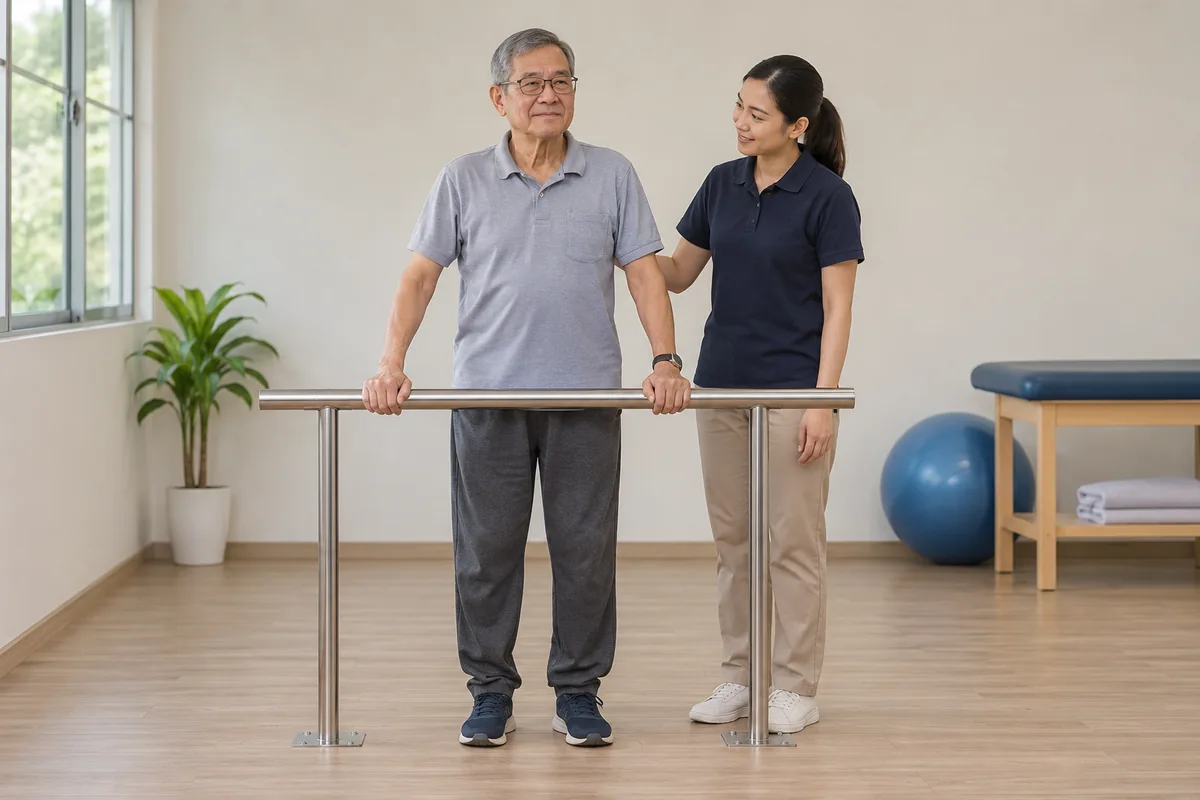
What is geriatric physiotherapy?
Geriatric physiotherapy is physiotherapy for older adults, focused on strength, balance, walking and confidence in daily life. At Kinesio Rehab Ipoh, a physiotherapist visits your parent at home anywhere in Ipoh. We assess how they move in their own house and build a plan around what matters to them.
That may be climbing the stairs to bed, walking to the kopitiam or getting up from the toilet without a hand. We work with the person and the family so the plan fits real life.
Who does geriatric physiotherapy help most?
It helps older adults whose daily movement has quietly shrunk. The parent who now avoids the stairs, stops the morning walk or holds the wall in the bathroom is the one who gains most.
It also helps people coming home after a fall, a hip fracture, an operation or a hospital stay, when weak legs make home feel unsafe. And it helps the adult child in KL, Penang or Singapore who worries from a distance and wants a clear plan for a parent in Ipoh.
Ipoh has reason to take this seriously. Perak had the highest share of residents aged 65 and over of any Malaysian state in 2026, at 10.8% [1].
Which problems do we help with?
We treat the changes that make later life harder, not only a single diagnosis.
- Poor balance, dizziness and fear of falling, covered in balance and falls.
- Weakness and slow walking after illness, covered in deconditioning.
- Joint pain from wear and tear in the joint, such as the knee (knee osteoarthritis).
- Recovery after a hip fracture.
- Care for a person who spends most of the day in bed, covered in bedridden patient physiotherapy.
Stroke and other nerve conditions are covered in our neurological rehabilitation service. We adapt the plan when a person also has memory problems.
What techniques does the physiotherapist use?
We choose a few well-matched methods and explain each to the family. Here are the main ones.
- Strength training. Sit-to-stand practice, step-ups and light resistance for the legs and hips, because strong legs protect against falls.
- Balance training. Standing with feet close together, shifting weight, stepping over small obstacles and turning safely, made harder only as your parent improves.
- Gait training. Practising a steadier walking pattern, with the right walking stick or frame fitted to the person.
- Transfer training. Safer ways to get out of bed, off the toilet and into a car or chair, for the person and the helper.
- Joint and soft tissue techniques. Gentle hands-on work and stretching to ease stiff, painful joints so that exercise becomes possible.
- Positioning and passive movement. For a person who cannot leave bed, regular changes of position and moving the joints for them to prevent stiffness.
- Breathing and stamina work. Simple breathing exercises and graded walking for those who tire quickly, linked with our cardiorespiratory physiotherapy.
Does exercise really prevent falls?
Yes, and it is one of the best-studied ways to do so. A Cochrane review found that exercise reduced the rate of falls in community-dwelling older people by 23% [2].
The World Health Organization (WHO) recommends tailored exercise that challenges balance and builds functional strength, with regular progression [3]. Tailored and progressive are the key words: the exercises must suit the person and become harder as they improve.
This is why a leaflet is not enough. A physiotherapist watches how your parent moves and decides the next safe step.
What does the first session look like?
Here is the path from your first message to the first visit.
- You message us on WhatsApp with who it is for, what is hard and the area of Ipoh.
- We reply with a few questions and a quote for the plan we would suggest.
- The physiotherapist arrives, listens to your parent’s story and asks about medicines, past falls and worries.
- We check strength, balance, walking and getting up from a chair, and look at the bathroom, bed and stairs.
- We start treatment in the same session and teach a short routine your parent can repeat daily.
- We agree goals and the number of visits, and you can ask for a short message after each visit.
What can you do this week?
Small changes make a difference.
- Ask your parent what they have stopped doing, and write the list.
- Check the bathroom: a non-slip mat, a grab rail if possible, and light at night.
- Watch them stand from a chair without using their hands. Note how it goes.
- Make sure shoes or slippers grip and fit.
- Keep a list of medicines and bring it to the first visit.
When is another route better?
Go to the emergency department after a fall with a head injury, severe pain or a limb that looks out of shape. Go too if the person cannot get up or bear weight. Sudden confusion, facial droop, slurred speech or weakness on one side may be a stroke.
For dizziness that is new, or a worry about medicines, speak to your doctor first. For everything else, tell us and we will say whether physiotherapy is the right next step.
Should we start at home or at the centre?
For older adults, a home visit is the practical start, because the assessment sees the real house and the trip out is tiring. Our Canning Garden centre, opening soon, will suit those who travel well and want equipment around them.
Prices differ between the two, and we send a quote on WhatsApp after you describe your parent. See home physiotherapy for how a visit works.
| Home visit | Canning Garden centre (opening soon) | |
|---|---|---|
| Best for | Frailty, recent hospital stay, bedridden care | Parents who travel well and want equipment. |
| Sees the home hazards | Yes | No. |
| Available | Now | Opening soon. |