What is post-surgical rehabilitation?
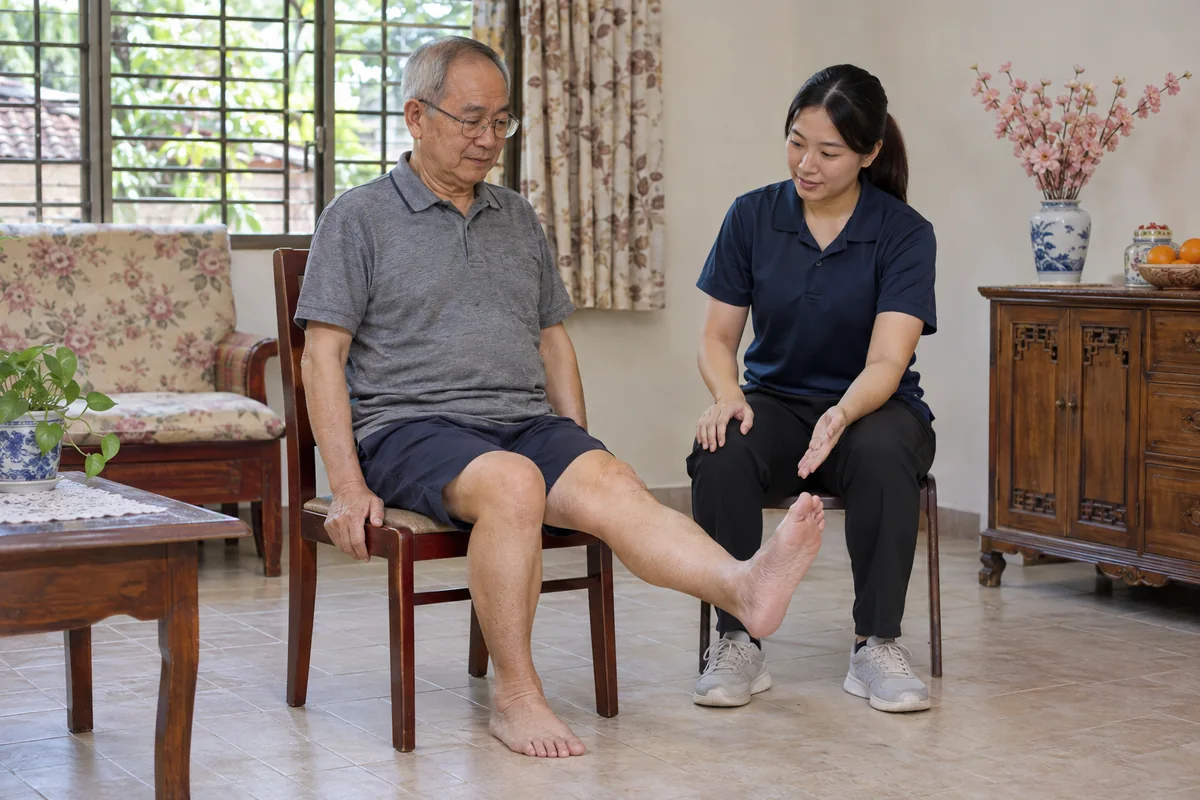
Post-surgical rehabilitation, also called post-operative physiotherapy or post-op rehab, is guided recovery that takes you from the ward back to doing things for yourself. Kinesio Rehab Ipoh provides it as home physiotherapy across Ipoh, with a physiotherapist who follows your surgeon’s protocol and builds the plan around your own house.
A physiotherapist helps you move safely, ease pain and swelling, regain strength and range of movement, and return to daily tasks. It works alongside your surgeon, not instead of them.
Who does it help most?
It helps anyone discharged after an operation who now has to manage a bed, a bathroom and stairs without ward staff. That includes an older adult after a hip fracture repair, a working adult after a spinal operation, and an active person after a ligament reconstruction.
It also helps the family. If you live in KL, Penang or Singapore and arrange care for a parent in Ipoh, we agree the plan with you by message. A helper at home can sit in on visits.
These visits run through our home physiotherapy service.
Which operations do we help with?
We see people after the common orthopaedic operations below. Each has its own page with more detail.
- Knee replacement and hip replacement, for worn joints.
- Anterior cruciate ligament (ACL) reconstruction, for a torn knee ligament.
- Rotator cuff repair, for a torn shoulder tendon.
- Spinal surgery, such as decompression or fusion.
- Fracture recovery after plates, screws, pins or a cast.
If your operation is not listed, ask us. We say clearly if it needs a specialist team beyond ours.
What does the surgeon decide, and what do we do?
Your surgeon’s protocol comes first. It sets weight-bearing limits, movement restrictions, wound care and the date of your next review. We follow it exactly and ask you to confirm anything unclear with the surgeon’s team.
Inside those limits, the physiotherapist decides how to practise, progress and teach the movements.
| Your surgeon | Your physiotherapist | |
|---|---|---|
| Decides | What is safe and when, including limits and review dates | How to exercise safely inside those limits |
| Checks | The operation site and healing | Movement, strength, balance and daily function |
| Helps with | Wound, medicines, scans, complications | Walking, stairs, bed, bathroom, confidence |
Evidence shows how much of this plan rests on the surgeon’s protocol. A clinical practice guideline for physical therapist management of total knee arthroplasty exists and was revised in 2026 [1]. After ACL reconstruction, a 2023 guideline names exercise as the main component but finds little evidence on dose, so the surgeon’s protocol sets the direction [2].
What methods does the physiotherapist use?
The methods change with the operation and the week of recovery. These are the ones we draw on most.
- Gait training. We teach you to walk with a frame, crutches or a stick, then to walk without one when your surgeon allows.
- Range-of-movement exercises. Gentle, repeated movements restore bending and straightening at a joint, within your surgeon’s limits.
- Progressive strengthening. We begin with simple muscle activation, then add resistance as the area can take it.
- Swelling and scar care. Positioning, elevation and gentle movement ease swelling. We touch the scar only once the wound is healed and the surgeon agrees.
- Transfer and stair training. We practise getting out of bed, off a toilet and up and down your own stairs, step by step.
- Balance training. Standing and weight-shift exercises rebuild the steadiness that surgery and bed rest take away.
- Education. We show you which movements to avoid, how to pace the day and when to call your surgeon.
Strength work for later stages connects with our exercise rehabilitation service.
What happens at the first session?
We begin with your papers and then watch you move. Here is how a first home visit runs.
- Message us on WhatsApp with the operation, the date and your area of Ipoh.
- We reply with questions, how a visit would run and a quote.
- At the visit, we read the discharge summary, the surgeon’s instructions and the medicine list.
- We look at the operated area for swelling and skin changes, without touching the wound, and check pain, movement, strength and balance.
- We watch you get in and out of bed, stand, walk and use the stairs.
- We agree goals, start gentle exercises in the same visit and tell you what to avoid.
Our guide to what to ask your surgeon before discharge helps you prepare.
What can you do this week?
A few changes in the house help straight away.
- Set up one floor for the first days if the stairs are hard.
- Put water, phone, medicine, glasses and the remote within reach of your chair or bed.
- Remove loose rugs and clear a path to the toilet.
- Keep your walking aid where you can reach it from the bed.
- Follow the pain medicine plan from your doctor.
Ipoh terrace houses usually have the bedroom upstairs, and a bathroom step or squat toilet adds one more challenge. Tell us about both when you message us.
Home visit or the Canning Garden centre?
Home visits across Ipoh are available now, whether you were discharged from Hospital Raja Permaisuri Bainun, Fatimah Hospital, KPJ Ipoh Specialist Hospital or Pantai Hospital Ipoh. Our Canning Garden centre is planned to open in February 2027.
Home suits the first weeks, when travel is tiring. The centre will suit the later stage, when you want equipment close by. Prices differ and are quoted on WhatsApp.
Our older adult rehabilitation page covers care for parents and grandparents.
Under Malaysian law, physiotherapists must register with the Malaysian Allied Health Professions Council (MAHPC) and hold a valid practising certificate [3]. Ask any provider for these details, including us.
When is another route better?
Call your surgeon, or go to the emergency department, if the wound is hot, red or leaking. Go too for a fever, a swollen painful calf, chest pain, sudden breathlessness, or new numbness or weakness.
These need a doctor first. We would rather you call than wait for the next physiotherapy visit.