What is neurological rehabilitation (neuro rehab)?
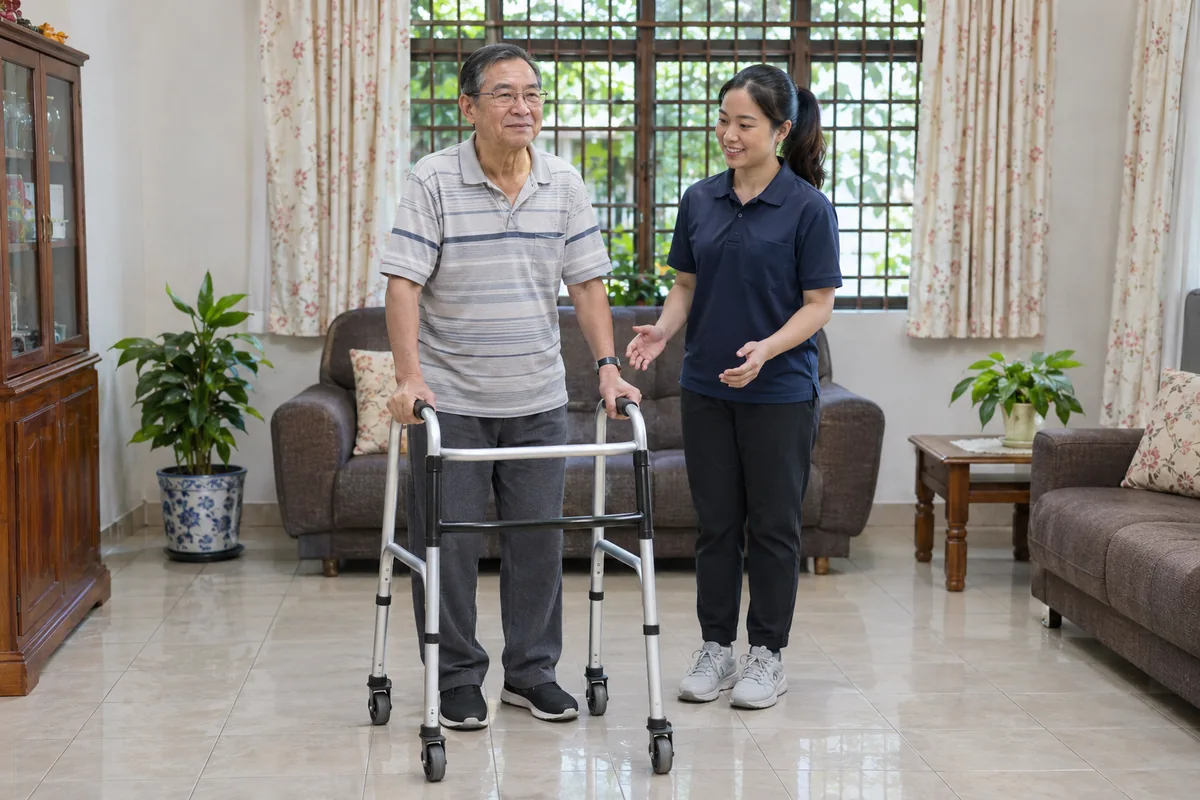
Neurological rehabilitation (neuro rehab) is physiotherapy for conditions that affect the brain, spinal cord and nerves, such as stroke, Parkinson’s disease and spinal cord injury. Kinesio Rehab Ipoh brings it to your home across Ipoh. You practise walking, balance and hand use where you live.
The aim is to help you do more for yourself, more safely. Our physiotherapist works on movement, and also on making daily tasks like getting out of bed, dressing and using the toilet manageable. This sits within our wider home physiotherapy service.
Who does neuro rehab help most?
It helps people whose strength, feeling, balance or coordination changed after a brain, spinal cord or nerve problem. It also helps people who lost confidence in walking after a long illness.
It helps the family just as much. A daughter lifting her father in and out of bed needs clear instruction, and so does a helper learning to guide a weak arm.
If you live in KL, Penang or Singapore, you can arrange it for your parent by message.
Which conditions do we help with?
We see people with the conditions below, and we agree goals around what each person wants back.
- Stroke: rebuilding transfers, walking, arm and hand use.
- Parkinson’s disease: walking, posture, balance and freezing steps. The World Health Organization (WHO) notes that physiotherapy-based rehabilitation can improve function and quality of life [2].
- Spinal cord injury: strength, sitting balance, transfers and safe positioning.
- Traumatic brain injury: balance, coordination and pacing the day.
- Multiple sclerosis: strength, balance and managing fatigue.
- Guillain-Barre syndrome: regaining strength step by step while nerves recover.
- Dementia and mobility: safer walking, getting up and fewer falls.
For Bell’s palsy, we guide facial exercises and eye care alongside your doctor’s treatment. Swallowing and speech problems go to a speech therapist or your doctor, because that is their area.
How big is stroke for Malaysian families?
Stroke changes a family’s life overnight. In Malaysia in 2019 there were an estimated 47,911 new stroke cases and 443,995 people living with stroke [1].
Those figures are people, and some need help with movement for months or years afterwards. A review of 96 stroke rehabilitation trials found that physical rehabilitation improved independence in daily activities [4]. Practice of 30 to 60 minutes a day, 5 to 7 days a week appeared effective [4].
That is why we teach a daily routine, not only the visit.
What methods does the physiotherapist use?
The methods depend on the condition and the goal. We name them plainly so you know what each one is for.
- Task practice. We repeat the real task, such as standing up from your own chair, because the brain relearns what it practises.
- Transfer training. We teach safe ways to move between bed, chair, wheelchair and toilet, for the patient and the helper.
- Gait training. We work on walking pattern and confidence, with a stick, frame or hands-on support as needed.
- Balance training. We shift weight, step and reach in graded steps, so the body learns to recover from a wobble.
- Strength and stretching. We strengthen weak muscles and ease stiff, tight ones, and show how to position a limb safely.
- Cueing for Parkinson’s. Counting, rhythm and floor markers help a freezing step start again. A Cochrane review found little difference between exercise types for Parkinson’s, so we pick the kind you will keep doing [3].
- Hand and arm retraining. We use the weaker side in everyday tasks and add sensation and mirror practice.
We also teach energy pacing, so a tiring day does not undo progress. Families learn what to repeat daily and how to assist without pulling on a weak arm.
What does the first session look like?
We listen to the story, read your papers, and then watch you move. We also look at the home layout, such as the step at the door, the bathroom and the terrace-house stairs.
- Message us on WhatsApp with the diagnosis, the area of Ipoh and what matters most.
- We reply with questions, how a visit would run and a quote.
- At the visit, we test strength, muscle tone, sensation, balance and walking.
- We start treatment in the same session.
- We agree two or three goals, such as “walk to the front gate” or “dress without help”.
- You leave with a small set of exercises, and the family is shown how to support them.
What can you do this week?
Start with safety and one small daily habit. Clear a walkway from bed to bathroom, remove loose mats and put a sturdy chair with arms where the person practises standing.
Gather the discharge summary, scan reports and medicine list in one folder. Then pick one daily task, such as standing practice beside a chair, and keep it short and regular. Send us what you notice and we will adjust the plan.
Home visit or our Canning Garden centre?
A home visit is the practical start for most people with a new or serious neurological problem. It avoids tiring journeys, and we see the real setting. Our Canning Garden centre, opening soon near Fatimah Hospital, will suit people who travel well and want a gym setting.
| Home visit | Canning Garden centre (opening soon) | |
|---|---|---|
| Best for | New or serious problems, tiring journeys, wheelchair users | People who travel well and want gym equipment |
| Available | Now, across Ipoh | Opening soon |
| Price | Quoted on WhatsApp | Quoted separately on WhatsApp |
Older adults with more than one health issue can read about older adult rehabilitation. Our exercise rehabilitation page explains how we progress exercises.
When is another route better?
Call an ambulance or go to the emergency department at once for sudden facial droop, arm weakness, slurred speech, severe headache, sudden loss of vision or sudden confusion. Time matters, so do not wait for a physiotherapy visit.
Tell your doctor about new swelling in one calf, chest pain, fever, a new fall, or a sudden change in strength or feeling. If swallowing, speech or memory is the main problem, your doctor or a speech therapist leads and we work alongside them.