What is paediatric physiotherapy?
Paediatric physiotherapy (also called pediatric or children’s physiotherapy) is physiotherapy for babies, children and teenagers whose movement, strength, balance or coordination is not developing as expected. It also helps children recovering from an injury or operation. At Kinesio Rehab Ipoh, a physiotherapist brings it to your child’s home in Ipoh and teaches you how to carry it on between visits.
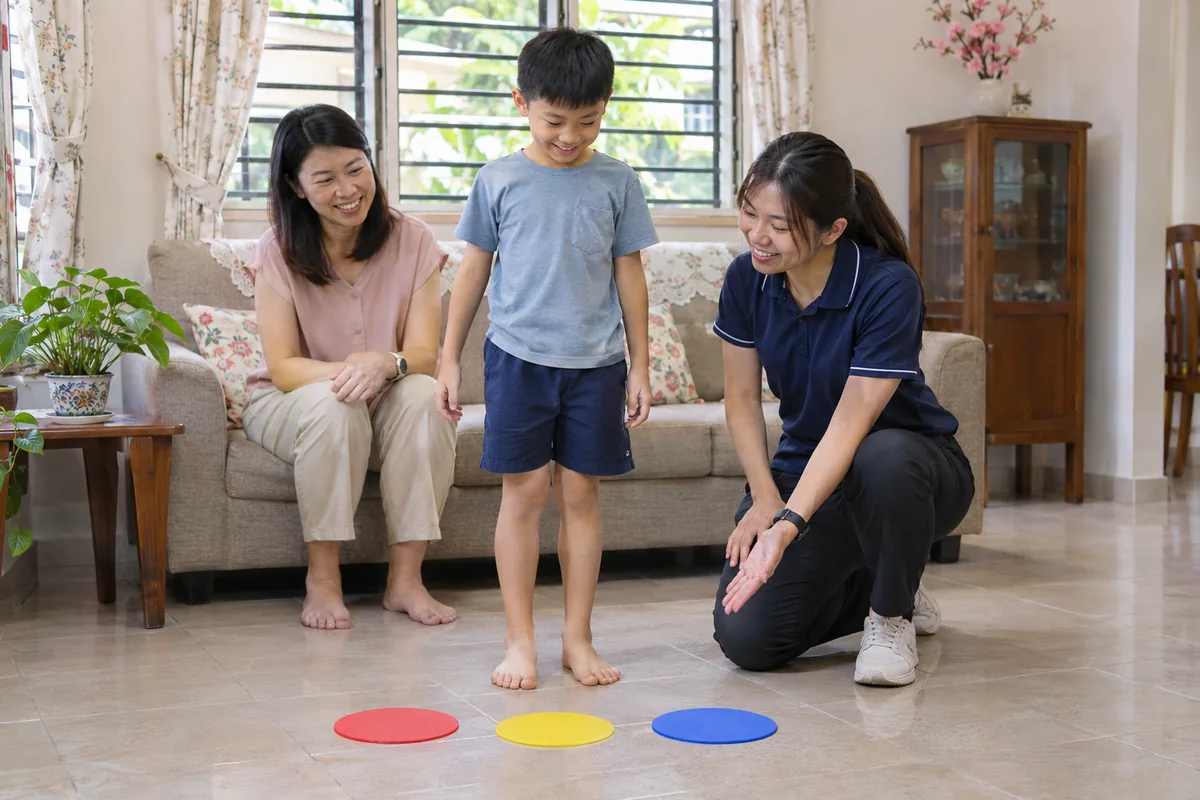
The work is built around play, because a child learns a new movement far more readily while enjoying it. You stay in the room throughout, and you leave each visit knowing what to do next. Our home physiotherapy page explains how every home visit is run.
Who does paediatric physiotherapy help most?
It helps the child whose movement worries a parent, and the parent who wants a straight answer. Some families come with a diagnosis, such as cerebral palsy, and want a plan for daily life. Others come with only a feeling that something is different, and want to know whether to wait or act.
It also helps families who share childcare. In Ipoh, grandparents may mind the children while parents work, and a grandparent can sit in on the session and learn the same activities.
A normal range is wider than most parents expect. The World Health Organization (WHO) Motor Development Study of 816 children found that walking alone first appeared anywhere between 8.2 and 17.6 months [1]. A cousin who walked early does not mean your child is behind.
Which conditions do we help with?
We see babies from the first weeks, through the toddler and school years, to teenagers. These are the reasons parents message us about most.
- Developmental delay and late milestones such as sitting, crawling or walking (motor development concerns).
- A head tilt, a preference for one side or a flat head shape (torticollis).
- A diagnosis such as cerebral palsy, where we work on strength, positioning and everyday movement.
- Walking on tiptoes after the usual age for walking (toe walking).
- Sports injuries and posture problems in school-age children and teenagers (children’s sports injuries). Teenage athletes also benefit from our sports rehabilitation methods.
What techniques does the physiotherapist use?
Everything we use is chosen for the child’s age and ability. Here is what the methods are, in plain words.
- Play-based movement practice. We turn a target skill, such as reaching, rolling or climbing, into a game, so your child repeats it again and again without noticing.
- Gentle handling and positioning. For a baby with a head tilt, we guide the neck and body into the positions that encourage balanced movement.
- Stretching and mobilisation. Tight muscles or stiff joints are moved slowly within your child’s comfort, and we show you how to do this at home.
- Strengthening through games. Squatting to pick up toys and climbing stairs build the muscles for standing and walking.
- Balance and coordination training. Stepping stones, ball games and obstacle paths train the skills that stop a child tripping.
- Gait practice. We watch how your child walks, then practise heel-to-toe steps, turning and changing speed.
- Parent coaching and a home programme. You get two or three short activities that fit into bath time, meals and play.
For a child with a neurological condition, we work together with the approaches described on our neurological rehabilitation page.
What does the first session look like?
The first visit is an assessment, a plan and a few things to try, all in one calm hour or so at your own pace.
- You message us on WhatsApp with your child’s age, your worry and your area of Ipoh, and we reply with a quote.
- The physiotherapist arrives, says hello to your child first, and asks you about pregnancy, birth, early milestones, health and sleep.
- We watch your child play, because natural play shows how they move more truthfully than a test.
- We check strength, muscle tone, joint movement, balance, posture and the skills expected for their age, stopping at once if your child is upset.
- We explain what we found in plain words and start a few play activities in the same session.
- We agree on goals, how frequently to visit and when we will review progress together.
What can you do this week?
Start with floor time. Let your baby or toddler play on a firm mat or floor, with toys placed to the left, right and a little out of reach. Avoid long periods in a seat, carrier or walker.
Write down what worries you, with the date you first noticed it. A short phone video of your child walking, crawling or turning their head helps us see what you see.
If a milestone looks late, compare it with the range, not a single age. Our baby milestones guide lays out the ranges.
Home visit or the Canning Garden centre?
Home visits across Ipoh are available now and suit most young children, who move best on their own floor. Our Canning Garden centre, near Fatimah Hospital, is opening soon and may later suit older children who want equipment, sports training or a group setting.
Prices for home and centre are different, and we quote on WhatsApp after you describe your child. If you work in KL, Penang or Singapore, you can message us from anywhere. A grandparent or carer at home can attend the visit.
When is another route better?
See your child’s doctor promptly if a baby cannot hold up their head or your child has stopped doing a skill. Do the same for limbs that feel very floppy or stiff, or a child who seems unwell.
Go to the emergency department after a head injury with vomiting, drowsiness or unusual behaviour. Go too if a fever comes with a stiff neck.
Sometimes the right person is not a physiotherapist.
A Malaysian rehabilitation association, quoted in The Star in April 2026, describes physiotherapists as trained in movement science and clinical assessment [2]. Occupational therapists focus on daily living function instead [2]. The table shows who to ask first.
| Your worry | Who to ask first |
|---|---|
| Late sitting, walking or climbing, tiptoe walking, head tilt | Physiotherapist |
| Difficulty with buttons, handwriting, feeding or play skills | Occupational therapist |
| Late or unclear speech, trouble swallowing | Speech therapist |
| Loss of a skill, seizures, a very unwell child | Doctor or emergency department |
We say so openly if your child needs another professional, and we work alongside them. Read how child physio, occupational therapy and speech therapy fit together in our guide for parents.